
This season, as I prepare to race Unbound, I’m focused on aerobic endurance training in the base period. The base period is often referred to as “training to train” which I used to interpret to mean that the base phase was less important to race performance and could be less intentional. This season, I’m reframing my thinking and making this phase the foundation of my annual training plan.
The base period is when the main focus should be improving aerobic endurance through an increasingly higher volume of low intensity training. Your aerobic endurance accounts for the majority of race day fitness, meaning the base is where most of your race day performance is built.
Three Things I’m Changing This Year to Get Faster and Fitter
I had good results in my last two triathlon seasons. I finished on the podium in my first Ironman, and qualified for Kona in my second. But even after crossing the finish line in Kona in a time I was happy with, I still felt like I had hit a fitness plateau that season. This year, I’m making some changes to how I approach the base period, hoping race day will feel like the best I can do—without getting burnt out or dropping the ball with my job and family.
Change #1: Re-emphasizing aerobic endurance and de-prioritizing high intensity training
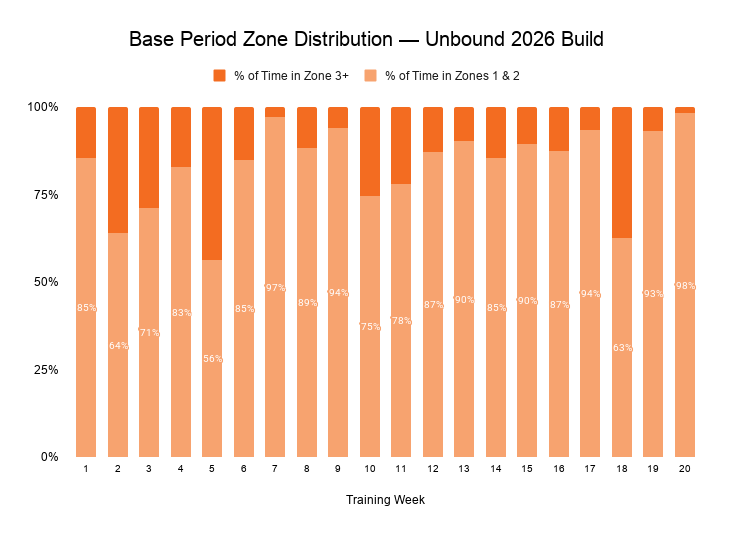
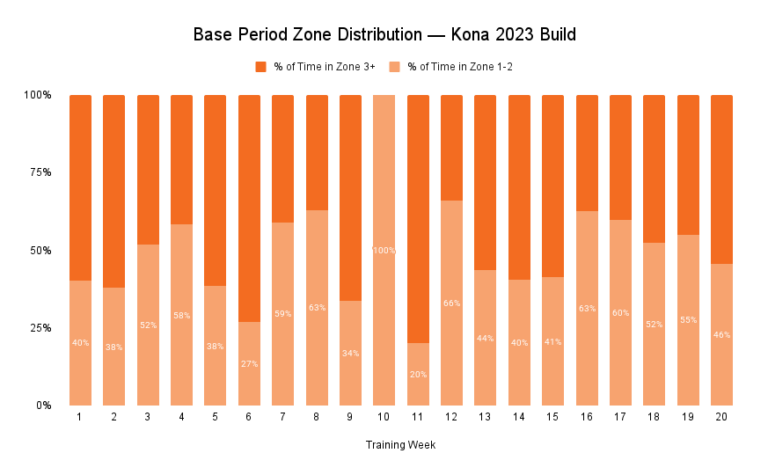
My focus is on aerobic endurance (zones 1 to 2), ending workouts before fatigue sets in, and adding gym strength and skills work.
Early base period:
I spent a lot of time improving my bike handling skills. I spent several months mountain biking before my training season really started. My biggest limiter on the bike leg of Kona was descending and cornering—I’m not very confident in either skill, and when I ride scared, I ride slow. Mountain biking helped me practice body position and learn to apply control with my feet, both of which give me more control and confidence.
Late base period:
I’m introducing some higher intensity zone training. The goal of base period training remains fairly general—not in the sense that I’m doing much other than biking, but in the sense that each workout mainly aims to improve my overall aerobic endurance rather than preparing me for a rolling hills gravel race. Because this phase is still general training, I’m using this time to focus on zone 4 and 5 anaerobic capacity. Later, in the build period when workouts become more race-specific, I’ll focus more on some zone 3 efforts and hills, because that’s what my race will demand.
Change #2: Spending more time deliberately practicing skills
Deliberately practicing skills works best when you’re fresh—it’s difficult to maintain correct technique when tired. The early base period, when fatigue should be low because the focus is on aerobic endurance, is a great time to work on skills. I also spent significant time during my unstructured pre-season on the mountain bike specifically working on skills that would improve my key limiter when I returned to gravel. My biggest limiter on the bike leg of Kona was being scared on steep descents, and this was a key skill I wanted to improve before Unbound.
Change #3: Training less overall with no multiple sessions per day
Instead of an aggressive schedule which peaked at over 20 hours of training per week, this season I’m eliminating multiple sessions per day and aiming for less training overall. Life is busier these days with a young family and career to prioritize ahead of training. I still have a goal of high performance, but need more balance to avoid burnout. It’s easier to accomplish this when I’m only focused on one sport instead of three. I expect more sleep and recovery this season will lead to strong performance with less training time.
Here’s How I Organized My Base Period
My base period was scheduled to last 20 weeks. The switch from loosely structured training to intentional planning for this 20-week base phase was a little murky. I’m a new mom with a career to balance, so it wasn’t realistic to flip a switch and expect perfect compliance to a training plan. I don’t have perfect compliance, and really only aim for 80% of the plan. Between holidays and general life interruptions, I’m not going to be able to do everything I scheduled. But I like to have it all scheduled as a starting point to tweak as needed. I used to get upset about missing any scheduled training. This year, I’ve decided to give myself permission to miss about 20% of what I put on the schedule.
My 20-week base period is organized into five 4-week cycles. The first two cycles have the same total training time, the next two are slightly more volume, and the fifth cycle is my highest volume. In the early base cycles, I was almost exclusively focused on zone 2 riding, most of that indoors because of the weather and general life constraints. When I did get outside, I went mountain biking because that gave me the best opportunity to improve bike handling skills.
In the later part of the base period, I introduced some zone 4 and zone 5 intervals. I’m saving zone 3 work for the build phase because zone 3 is more race-specific for my long bike race than zone 4 and zone 5 training. The goal of the annual training plan is for training to increasingly imitate the demands of my race, so the most race-like workouts come later.
What Each Week Looks Like
I incorporate one zone 5 session and one zone 4 session weekly as “hard” days. One day is a longer ride (building up from 4 hours) but all aerobic. The rest of the weekly volume comes from easy volume however works best for my schedule.
Measuring Success: How Do I Know If My “Easy” Training Plan Is Working?
When workouts are designed to be easy and end before fatigue sets in, it can be hard to know if you’re improving your fitness. Here’s how I track progress:
Efficiency Factor (EF)
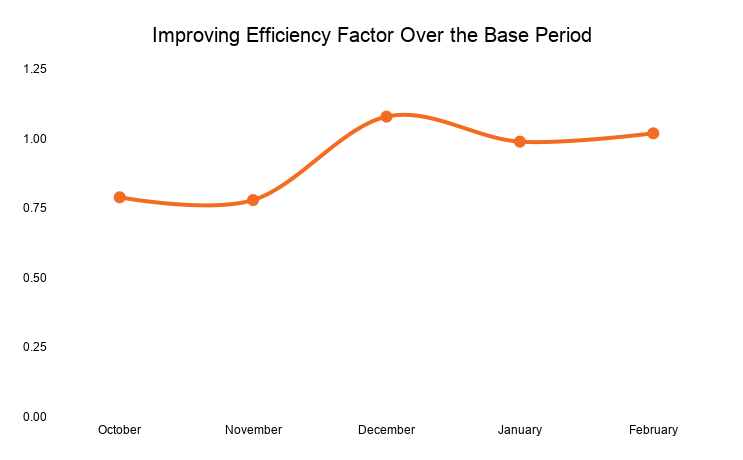
If you train with a power meter and upload your workouts to TrainingPeaks, efficiency factor is an easy daily metric to track. It’s the ratio of normalized power (a TrainingPeaks trademarked calculation) to average heart rate. You don’t need to see this increase each day, but when you look back over several, you should see an upward trend. I get both of these numbers when my data uploads to my training software and can calculate EF there.
Looking at my own data from October, when I started intentional base training, to early February, my average EF went from the 0.7 range to the 1.0 range. That’s a 29% improvement. This gives me comfort that I’m doing the same work at lower effort, even when I feel like I’m going slow and worry whether I’ll be race-ready.
FTP Testing
FTP is another cycling fitness metric that most cyclists are familiar with. This one is harder to use for frequent progress checks because you shouldn’t be doing a 20-minute high-intensity fitness test weekly. FTP is better suited for testing every 4-8 weeks rather than tracking week-to-week fluctuations. With regular FTP tests you can reset your training power zones as you improve, ensuring you continue to train in the right zones throughout the season.
When I observed my FTP over the first several weeks of the Base Period, I saw a 7% improvement.
Time To Go To Work!
I’m optimistic about the improvements I made in this base phase. The data shows I’m moving in the right direction, and more importantly, I’m enjoying my training more than I have in the past.
Whether this translates to a strong performance at Unbound remains to be seen. I’ll keep sharing updates as the season progresses. If you’re working through your own base period or have lessons from past seasons, I’d love to hear what’s working (or not working) for you.