
This self-supported 350-mile bike race through remote Kansas — starting in the afternoon heat and finishing somewhere in the middle of the night — demands as much planning and logistics as the three disciplines of a full Ironman. Maybe more.
Here’s everything I’m running and why:
Table of Contents
The Bike
What I wanted in a gravel bike frame and wheelset was optionality. I get that with the Rodeo Labs Trail Donkey 4.2 and the Logos Components Époche G2 wheelset. The Trail Donkey has massive tire clearance up to 2.4” and I got to choose every spec — it’s an amazing company to work with and a genuinely fun bike to ride. I’ve swapped through a few tire sizes during this build, from 45mm to 50mm and now up to 2.25”, dialing in what works best for mixed terrain.
The Époche rims accommodate tires ranging from 35mm to 2.4”, which covers everything I’d ever need in a gravel setup. I like the simplicity of a 1x drivetrain with SRAM Rival AXS XPLR, but I still have 13 gears — and I use all of them.
| Component | Spec |
|---|---|
| Frame | Rodeo Labs Trail Donkey 4.2 |
| Wheelset | Logos Components Époche G2 |
| Tires | Vittoria Peyote 2.25”, race casing |
| Drivetrain | SRAM Rival AXS XPLR 1x13, 10-46T cassette, 42T chainring |
| Seatpost | Roval Terra C |
| Saddle | S-Works Power EVO with Mirror |
A note on the tires: yes, these are mountain bike tires. The wider volume acts as suspension over rough terrain — and over 350 miles, reduced fatigue matters more than marginal rolling resistance gains. The extra tread also gives me more confidence in mud and on unpredictable surfaces. Whether the rolling resistance trade-off is real depends on how rough the road is and who you ask.
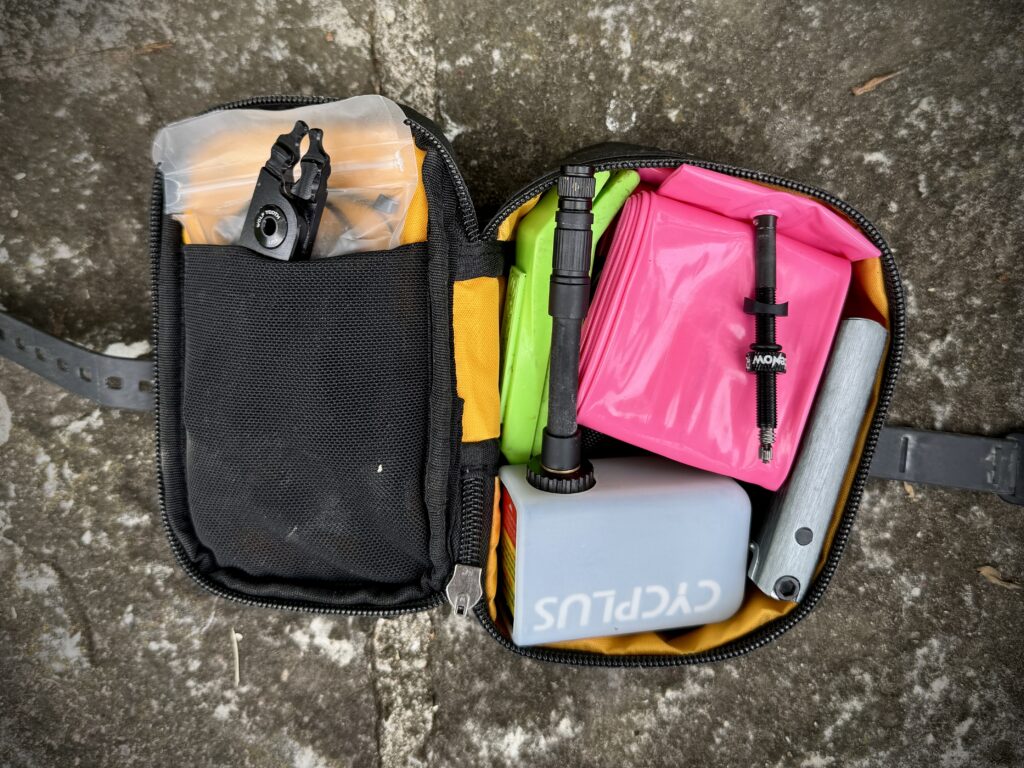
Flat and Tool Kit — Four Ways to Fix a Flat
Flats are a serious risk at Unbound — not just small punctures but large sidewall tears from sharp Flint Hills rock. I have multiple methods for handling them: tubeless plugs for smaller punctures, tire boots and duct tape for a larger tear, and three TPU spare tubes if it comes to that. TPU tubes are lighter than butyl and pack smaller — you can carry three where you’d carry one. A mini air compressor reinflates faster and gets you moving sooner. A hand pump is slower but more reliable. Spare valve cores because I’ve cracked a few in training. Tire levers to get the job done.
The other risk on rough terrain is drivetrain damage. I actually watched a rear derailleur get ripped clean off a bike by packed mud at training camp in Emporia — one of those things you can’t unsee. So I’m carrying a spare UDH hanger just in case. Small enough that there’s no reason not to. Plus spare master links, chain links, and a chain breaker.
| Item | Notes |
|---|---|
| Tubeless plugs | For smaller punctures |
| Tire boots + duct tape | For sidewall tears |
| 3x TPU spare tubes | Lighter and smaller than butyl |
| Mini air compressor | Faster reinflation |
| Silca Graveliero hand pump | More reliable than CO2 alone |
| Spare valve cores | Learned this one the hard way |
| Tire levers (x2) | |
| Spare UDH hanger | Derailleur protection |
| Master links, chain links, chain breaker | Drivetrain repair |
A note on the hand pump: I upgraded to the Silca Graveliero mid-build after a cheaper pump failed during a training ride. Two reasons: the larger barrel gets more volume into the tires faster, and it clips onto the presta valve rather than screwing on. My old pump kept unscrewing the valve cores when I tried to remove the hose. Not a mistake I wanted to repeat at mile 200 in the dark.
Hydration — Up to 4.5L Capacity
Pit stops on the 2026 course are 45–81 miles apart. I’ll hit every one, even the shorter intervals, so I won’t need my full capacity for most of the race — except that last 80-mile stretch. I also like having extra room for a variety of drink types especially several hours into when what was working stops working and you need options.
My Osprey Dyna hydration vest carries the bulk of it with a 3L bladder. Keeping weight off the bike frame matters when you might have to pick the bike up and carry it through a mud section. One 1L bottle and one 500ml bottle in the cages round it out. I chose a trail running-type vest specifically because I love pockets — it has tons of small storage spaces for gels and fits the 3L bladder with room to spare.
Nutrition — Filling A Frame Bag Full of Food
My Tailfin 2.3L frame bag is dedicated entirely to food. I’ve been using GU Energy liquid nutrition throughout this build and it works exceptionally well for me over several hours of sustained effort. The problem is I won’t be able to find GU Energy at gas station pit stops, so I’m carrying single-serve packets in my frame bag to have it available the whole ride. Alongside those I’ll carry GU gels for the full race. The 1.5L top tube bag holds a power bank and whatever snacks I pick up at stops along the way.
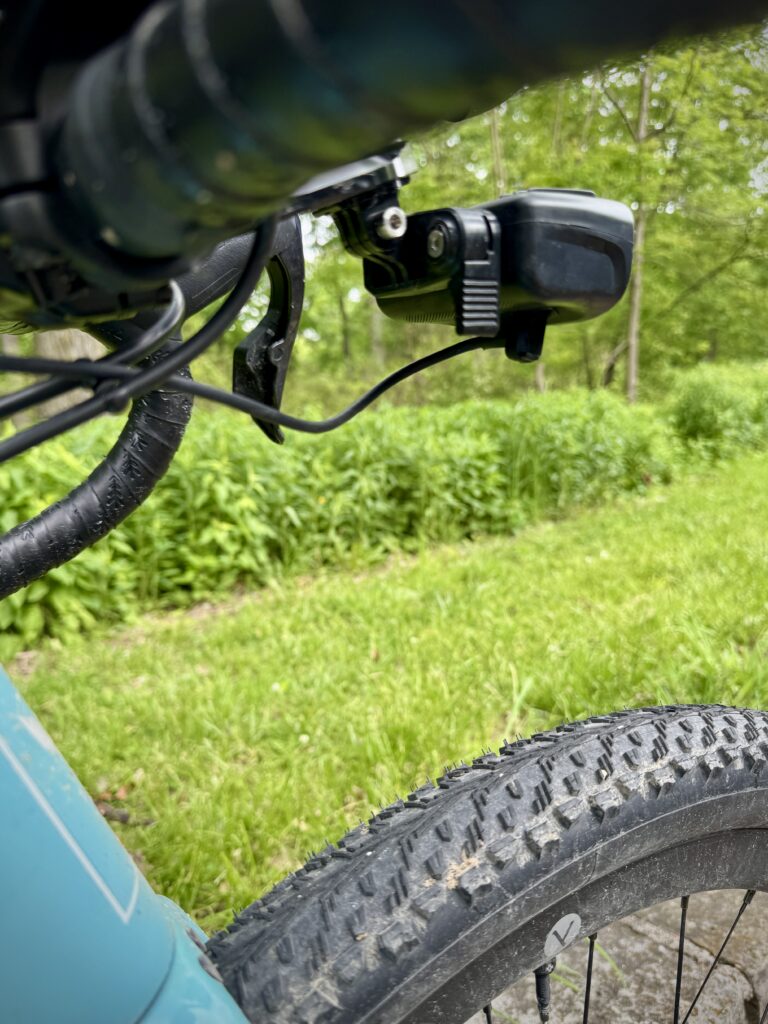
Lights — Because a 3pm Start Means Racing Through the Night
I chose the Outbound Lighting Detour for the handlebars and the Outbound Lighting Hangover for the helmet. Outbound Lighting built their reputation in the MTB space — if your lights are good enough for bombing down singletrack at night, they’re good enough for straightaway gravel roads at 2am. The two lights together cast wide and far, which gives me real confidence to keep up some speed on sections where the road surface is unpredictable in the dark.
Both are lightweight — I don’t notice the Hangover on my helmet at all. The trade-off is battery life, which is honestly not great. That’s the reason for the power banks.
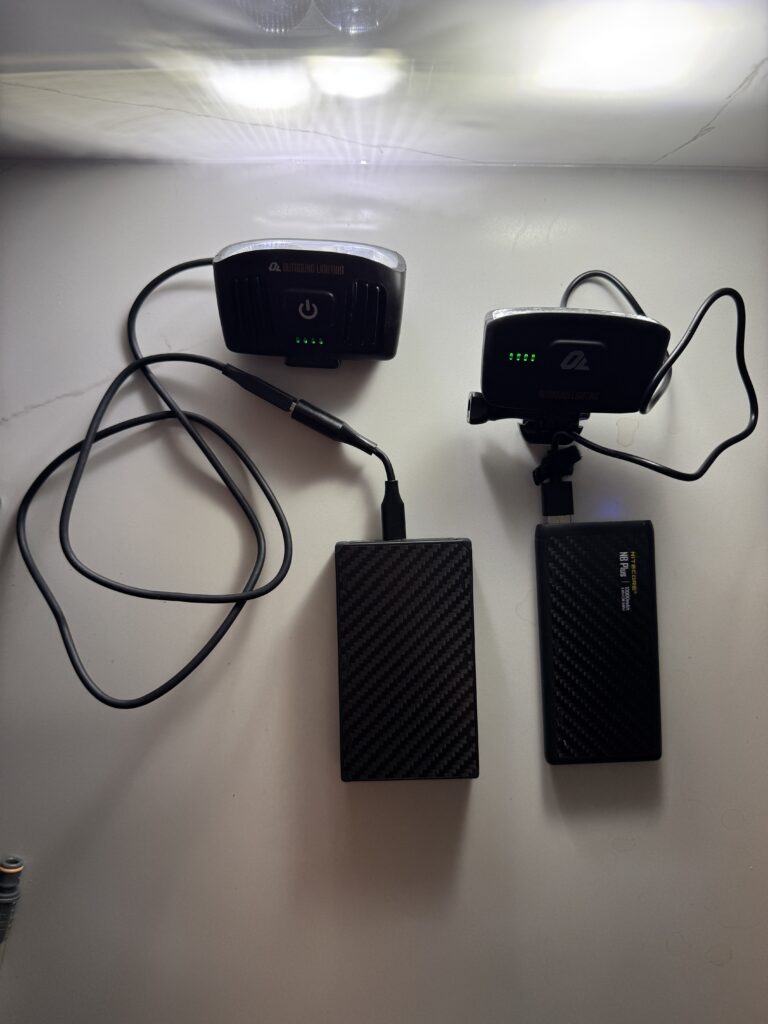
Power — Two Banks, No Apologies
One 20,000mAh power bank should be enough to run both lights through the night. One 10,000mAh backup because I’m paranoid and 350 miles is a long time to find out your Garmin battery doesn’t last as long as the spec sheet says.
Tech and Safety
Garmin Edge 550 for navigation with the course GPX loaded. I chose the 550 specifically for the tactile buttons — ever tried using a touchscreen in the rain? The answer is: once, and never again.
I’m also carrying a Garmin inReach Mini satellite communicator. Large sections of the course have no cell service and the inReach is required equipment for XL. It also lets my family track me in real time throughout the race — no supporters are allowed out on the course, so this is the only way they know I’m still moving out there.
How Am I Going to Carry All of This?
| Bag | Size | What’s In It |
|---|---|---|
| Tailfin Frame Pack | 2.3L | GU Energy packets, GU gels, Silca Graveliero hand pump, mud stick |
| Lumia Saddle Bag | XL | 2x TPU tubes, multitool, mini air compressor, 2x tire levers, tire boots, spare parts |
| Down tube storage | — | 3rd spare tube (last resort — difficult to access with frame pack installed) |
| Tailfin Top Tube Bag | 1.5L flip top | Power bank, charging cable, snacks |
| Tailfin Seat Tube Pack | 0.8L | Garmin inReach Mini, tubeless plug, emergency candy bar, helmet light (daytime) |
A note on the frame bag: I chose the Tailfin specifically for the rigid design — it doesn’t bulge as it fills up, which means my knees never rub against it. There’s also a flat left-side pocket that fits the mud stick perfectly.
A note on the seat tube pack: it won’t be full but I’d rather have a little extra room than not enough. Quick access to the inReach and a tubeless plug is the priority.
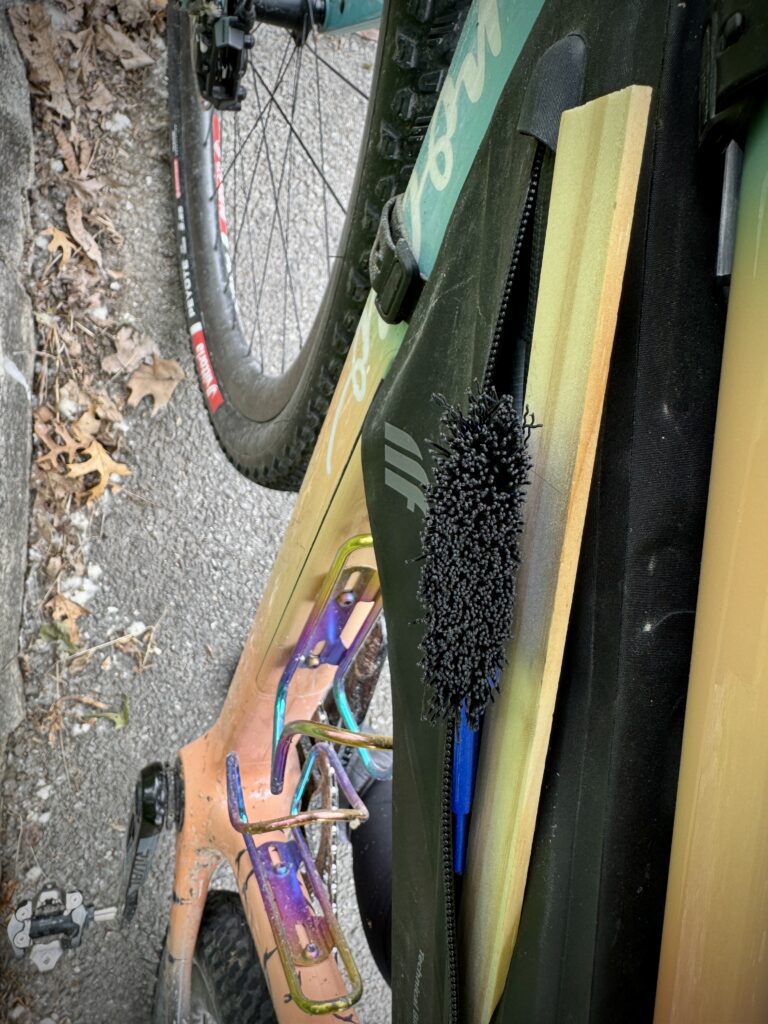
The Mud Stick: Essential Gravel Racing Gear When It’s Wet
Kansas gravel turns to clay after rain and packs into your tires and drivetrain in a way that your hands can’t clear. A paint stick — the kind used to mark parking lots — swipes it clean without tools. Weighs almost nothing, takes up no space. I’m bringing it because I went to training camp in Emporia and watched the Flint Hills turn into a mud pit. I’d rather have it and not need it.
What I’m Wearing for 350-miles of Overnight Gravel Riding
| Item | Why |
|---|---|
| Long sleeve jersey | Sun protection — Kansas in late May is brutal |
| Cargo bibs | Extra pockets are non-negotiable for a ride this long |
| Wool socks | Stay comfortable when wet. Wore these for Ironman Alaska with soaking feet after a freezing swim. Zero blisters. |
| Wide toe box shoes | Numb feet are the worst. Most cycling shoes run too narrow for me. |
| Neck gaiter | Sun protection, handkerchief, whatever it needs to be |
| Clear + shaded lenses | Sunglasses don’t work in the dark but you still want something keeping bugs and dirt out |
| Helmet | Obviously |
Total Bike and Gear Weight for Unbound XL
Bike and gear fully loaded: approximately 45 lbs. No weight weenies here.
My Complete Gear List for Unbound XL 2026
| Category | Item |
|---|---|
| Frame | Rodeo Labs Trail Donkey 4.2 |
| Wheelset | Logos Components Époche G2 |
| Tires | Vittoria Peyote 2.25” race casing |
| Drivetrain | SRAM Rival AXS XPLR 1x13 |
| Saddle | S-Works Power EVO with Mirror |
| Frame bag | Tailfin 2.3L Frame Pack |
| Saddle bag | Lumia XL |
| Top tube bag | Tailfin 1.5L Flip Top |
| Seat tube bag | Tailfin 0.8L |
| Hand pump | Silca Graveliero |
| Lights | Outbound Lighting Detour + Hangover |
| Power banks | 20,000mAh + 10,000mAh backup |
| Computer | Garmin Edge 550 |
| Satellite communicator | Garmin inReach Mini |
| Hydration vest | Osprey (trail running style, 3L bladder) |
| Nutrition | GU Energy liquid mix + GU gels |
What’s Next?
Race day is May 29. Full recap the week after. Then it’s on to building a gravel triathlon race series at the intersection of these two sports — follow to be the first to sign up.